




What a school log book can tell you – Shilbottle First School 1926 – 1941
Bailiffgate Museum has a number of school log books – originals or scanned copies. In its centenary year, we have taken a look at the log book of Shilbottle First School.
Yes, it tells you the totals of attendance, the staff comings and goings, school visitors, and the meter readings over the years. But, if you look behind these required and repetitive records, there is a glimpse into the social history of the period:
You can learn about the health of the children and the many health inspections there were. You can see how many childhood illnesses there were at the time: – diphtheria, scarlet fever, whooping cough, measles, chicken pox, mumps, influenza, impetigo and scabies.
On Friday 8th June 1928 the Head Teacher wrote:
“The average attendance fell ..….. due to the absence of children from large families where death had occurred, where a suspected case of scarlet fever existed, where children had no boots and where there were cases of seasonal sickness.”
In July 1940 the Head Teacher wrote:
“During the week ending 19 July a further twenty cases” of measles “were notified to the SMO. This brings the total number of children absent from this cause to 34. The disease is confined to the Inft Dept, chiefly, where the attendance for the week fell to 35%.”
You can see the modernisation that is carried out in the school building eg. the introduction of electricity in 1932, and its interest in the children’s welfare.
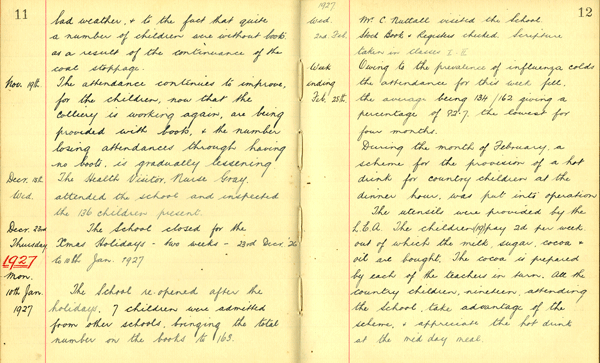
On 19 Nov 1926 the Head Teacher wrote:
“… the colliery is working again… and the number losing attendance through having no boots is gradually lessening.”
and in February 1927:
“ During the month of February, a scheme for a hot drink for country children at the dinner hour, was put into operation.”
Particularly notable is the impact of World War II.
There is a lot of information including that about positioning and digging the school shelter, taping the windows for protection against broken glass, gas masks, air raid drills and warnings, the arrival of evacuees, staff being called up, changes to school hours and holidays.
On 29 September 1938:
“During the afternoon of Thursday 29th Sept. The County Air Raids Precautions Officer met the managers and the Head Teacher at the school & a suitable site for ‘The Cover Trenches’ was chosen – along the three sides – W N & E – of the garden and the back of the school. Six shovels and four picks were requisitioned to enable the senior boys to commence the work of digging.”
In September 1939 the Head Teacher wrote:
“The first of the evacuees arrived on Wednesday afternoon, 6th Sept. when 18 school children one teacher and one helper from Wallsend were provided with billets. Caville School – Wallsend. …. Later, on Monday 11th Sept. three of the children returned to their homes, owing to their distress at being separated from their parents.”
In October 1939 the Head Teacher wrote
‘Since the beginning of the war Fire Drill and Instruction in Air Raid Precautions have been a regular feature of the school work.’
On 18 September 1940 he wrote:
“Mr WA Brown …. terminated his engagement as a CA on this date, as he was called up for military service.”
In October 1940:
“During the week ending 25th Oct a beginning was made to paste strips of book muslin 2” wide across the lower windows, as a protection against glass splinters.”
In April 1941:
The children were in the air raid shelters from 3:15 to 3:40 during an ‘alert’. The dispersal was carried out quietly and in an orderly manner.”
And in July 1941:
“The school closed for the first part of the summer holiday (two weeks) to enable the senior children to assist in the hay harvest in accordance with wartime instructions re holidays by the LEA.”
Look inside the cover, and there is a wealth of incidental information!